
Natural Born Exercisers are Musicophiliacs
The muscle-mind-music mix is a three-way street that can elevate everyday fitness toward pro-athlete level.
Dr. Phil Maffetone
Music has been essential for humans since the beginning. It kept our ancestors pacing stride for stride, honed hunting prowess, and forged bigger, sharper brains. Beyond communication and courtship, this primordial universal language also paved the neurological runway for spoken word. Yet, more recently, that communal heartbeat devolved into an unimaginative industrial machine dividing humanity into passive consumers and corporate creators.
Today, we routinely ignore our ancestral hardwiring—the biological machinery designed to leverage music for optimal health, athletic performance, stress management, and deep meditative focus.
Most elite athletes, though, instinctively grasp these ideas. They warm up the brain before the body, curating tracks to ignite energy, silence distractions, and vanquish pre-competition anxiety. It propels them straight into the meditative “zone.” But once the starting gun fires, the music stops.
Unfortunately, modern commerce has weaponized sound, training its sights directly on the consumer:
- Neurological hijacking: Music marketing exploits cognitive vulnerabilities to manipulate spending habits.
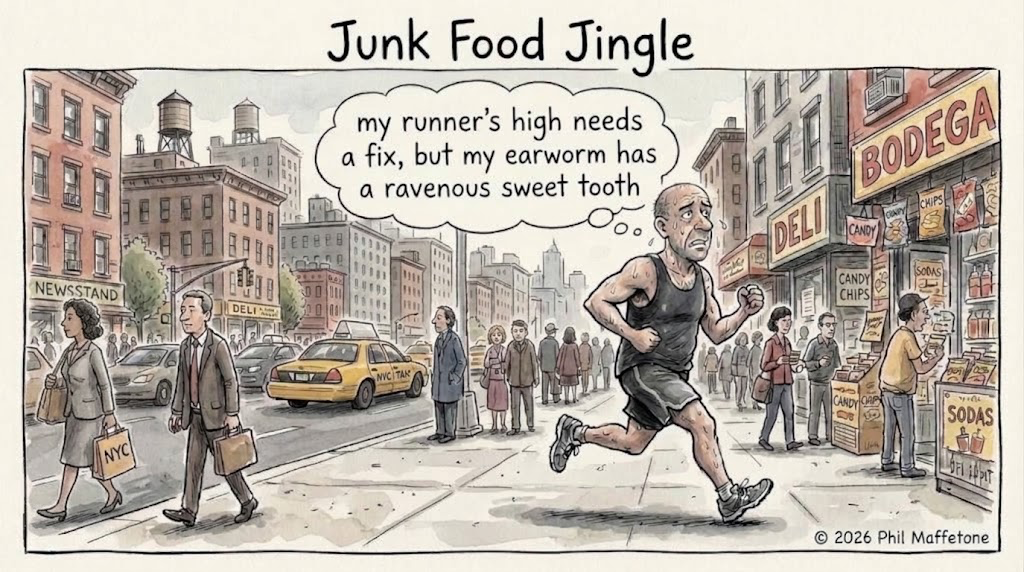
- The overtraining trap: Blaring high-decibel audio during workouts tricks the brain into pushing past safe boundaries. It’s a direct pipeline to hearing loss, burnout, and injury. Crucially, high-stress rhythms even skew metabolism away from fat burning toward sugar combustion—leaving you ravenous for junk food before, during, and after training.
Even driving soundtracked aggressive beats—once thought to help exercise—forces the autonomic stress response into overdrive, prioritizing sheer quantity over kinetic quality. Cue elevated heart rates, distorted gaits, and counterproductive fatigue.
When a music marketing jingle is selling you something, it loops relentlessly in your cranium. You’re now experiencing Involuntary Musical Imagery (INMI)—the classic earworm. These corporate earworms exploit pattern-recognition networks, sparking a literal “cognitive itch.” Your brain loops the track autonomously, quietly firing the vocal and motor pathways needed to hum and move to it. You are literally practicing the jingle subconsciously, making it devilishly difficult to evict.
Meanwhile, this sonic social bombardment pushes genuine, restorative music into the shadows.
The Remedy: Silence and Intentional Listening
Clear out the auditory clutter—commercials, blaring retail speakers, and mindless background noise.
Instead of wearing earbuds during training, listen to your body. Tune into muscle contractions, the dopamine-driven runner’s high, and your locomotor-respiratory-cardiac coupling (how breathing, heart rate, and gait align). Embrace the sound of silence. It sharpens bodily awareness, turning exercise into a flowing act of precision.
True performance benefits emerge when you treat music with respect—not as sonic wallpaper, but as an active engagement, akin to a cinematic masterpiece. So instead of an evening movie or TV show, listen to great songs. It’s a potent stress-antidote, smoothing the transition from a grueling workday or workout into restorative sleep. Try these two daily routines:
- Revisit Nostalgia: Spin your formative favorites—whether rock, folk, classical, or jazz (sidestepping commercial-heavy streaming traps). These are your personal oldies.
-
Explore the Uncharted: Dive into unfamiliar auditory waters listening to music you’ve never heard. Ask friends, family, or sample my original compositions like Rosemary, Can’t Remember Yesterday, or (for full speed emotion) Twice in One Lifetime.
I utilize both regularly, not during a workout but as active meditation. This music stimulates neurological pathways that trigger many physical benefits including muscle balance, relaxing gut tension and controlling cortisol. (For dancing, explore my full playlist here, and for those thoroughly addicted to listening while working out, my special exercise playlist).
Big Music and Modern Medicine
While we've been blessed with natural music therapy since antiquity, modern institutions have rushed in to regulate and profit from it. Once practiced organically by all humans who were also musicians, “official” music therapy has now been integrated into modern medicine requiring board-certified gatekeepers and licensing fees.
Just as Big Tobacco and Big Sugar derailed human health, Big Music has hijacked our evolutionary birthright. Creativity has been traded for algorithmic optimization, viral micro-trends, and cheap digital compression. Independent artists decry a rigged ecosystem where streaming royalties pay fractions of a penny while engagement metrics are artificially inflated.
Professional athletes wear their “game face” via customized anthems; we can similarly orchestrate our daily routines with intentionality and a wry smile.
Music drove our ancestor’s minds and bodies. Don't let algorithmic media shrink them. Bypass the junk food of sound, stick to authentic fuel, and keep developing.
**
These and other topics are explored in my book, “B Sharp! Your personal music journey to expand the mind, enhance the brain, and age well.”
Of course, like my music, I write my own original organic ideas, not AI.